





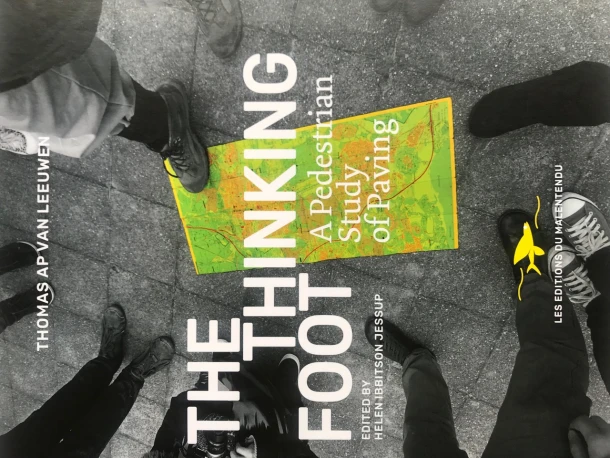
The Thinking Foot
A Pedestrian Study of Paving
€ 39,95(incl. BTW)
 Favorietenlijst
Het voordeel van lokaal bestellen bij Stumpel
 Gratis verzending bij bestelling vanaf € 25,-
 Uw bestelling graag thuis bezorgd? Wij bezorgen het tot aan de deur.
 Meer dan 140 jaar ervaring in boeken en kantoorartikelen.
 Vraag? Bel of mail ons! Of kom langs in één van onze winkels.
Beschrijving
The Thinking Foot is a study of history and associations. In method and form it claims to be no more (nor less) than an illustrated essay on the architectural expression of surface. It concentrates on the Earth on which we walk: not the Earth in depth (the underground world) nor the geological Earth, but simply the Earth as visible crust, as surface. The Thinking Foot is indeed about surface and in particular about how this surface was made into a ?civilized? theatre of communal existence. Civilization means turning things, mostly private or wild, into communal or civic use. Untreated surface becomes communal ground through paving. Paving has many qualities. It hardens the ground, it hides the ground, it equalizes the ground and it protects the ground. Aesthetics certainly play an important part in its appreciation, but on the whole paving is intended to be practical; the intention of paving is to be practical and useful. Throughout its evolution paving has proved to be a necessity with very little artistic ambition and almost no depth. It is surface, just that.
About the author: Thomas A P Van Leeuwen was professor of architectural history, cultural history and art criticism at Leiden University and at The Berlage Institute, Rotterdam, for many years. He had done research and taught at various post-graduate schools in Europe and the United States. He was Fellow of the American Council of Learned Societies, Harkness and Fulbright Fellow and Senior Fellow at the Center for Advanced Study in the Visual Arts, Washington DC.
Van Leeuwen?s approach to architectural history is mildly idiosyncratic. Contrary to regular practice, the Van Leeuwen method first strips down the architectural object to its smallest possible particle and then fans out to the widest possible ramifications. The Springboard in the Pond: An Intimate History of the Swimming Pool (1998) started off in architecture?s atomic beginnings as a simple hole in the ground in order to culminate in excursive explorations into man?s conflicting attitudes toward water. Columns of Fire: The Un-doing of Architecture, the third volume, largely published as articles in ea. Cabinet Magazine, Harvard Design Magazine and Hunch, describes architecture?s passionate relationship with fire. Fire the builder-Fire the destroyer. The London Reform Club House is part of this volume, since it was the first semi-public building in the United Kingdom to be constructed of fire-proof construction. That its kitchens were fired by ultra modern gas cooking ranges was not only an unprecedented improvement, but also a demonstration of the fact that the element Fire has two opposite characters. As an enthusiastic Reformer, Van Leeuwen had access to the building?s entrails where he found traces of its smallest common denominator, a one-horse-power steam engine that drove its cooking and ventilation works.
Thomas A P Van Leeuwen?s books also include a historical analysis of the contradictory ascent of the tall building The Skyward Trend of Thought: Metaphysics of the American Skyscraper (1986). These studies are part of a tetralogy with each volume centred on the relationship between architecture and one of the classical elements: Air, Water, Fire and Earth. The last volume deals with Earth: The Thinking Foot: A Pedestrian View of Architecture, an inquiry into the undervalued qualities of Surface, demonstrated by a history of paving and the various consequences of hard superficiality.
About the editor The editor of The Thinking Foot: A Pedestrian Study of Paving is Helen Ibbitson Jessup. Jessup is an art historian specializing in Southeast Asian art and architecture. Her books include Temples of Cambodia, the Heart of Angkor (2011), Art and Architecture of Cambodia (World of Art series, 2004), Sculpture of Angkor and Ancient Cambodia, Millennium of Glory (editor, with Thierry Zéphir, 1997), and Court Arts of Indonesia(1990). As a poet she accompanied the photographs of Kenro
Meer informatie
Druk
1
NUR-code
648
Gewicht
1370gram
Taal
Engels
Verschijningsdatum
15-11-2023
Auteur
Uitgever
Les Éditions du Malentendu | Jap Sam Books
Formaat
288 x 245 x 27 mm
ISBN
9789493329010
Verschijningsjaar
2023
Beoordelingen

Deze website maakt gebruik van cookies
